Modularization
Starting from the Need
From a cost efficiency perspective, most people would agree that the best thing would be to eliminate variation everywhere in the company. A company completely ruled by this idea – standardization – would produce one product for all customers. However, most people would also agree that this strategy in most cases would leave the company with too few – or not very satisfied – customers.
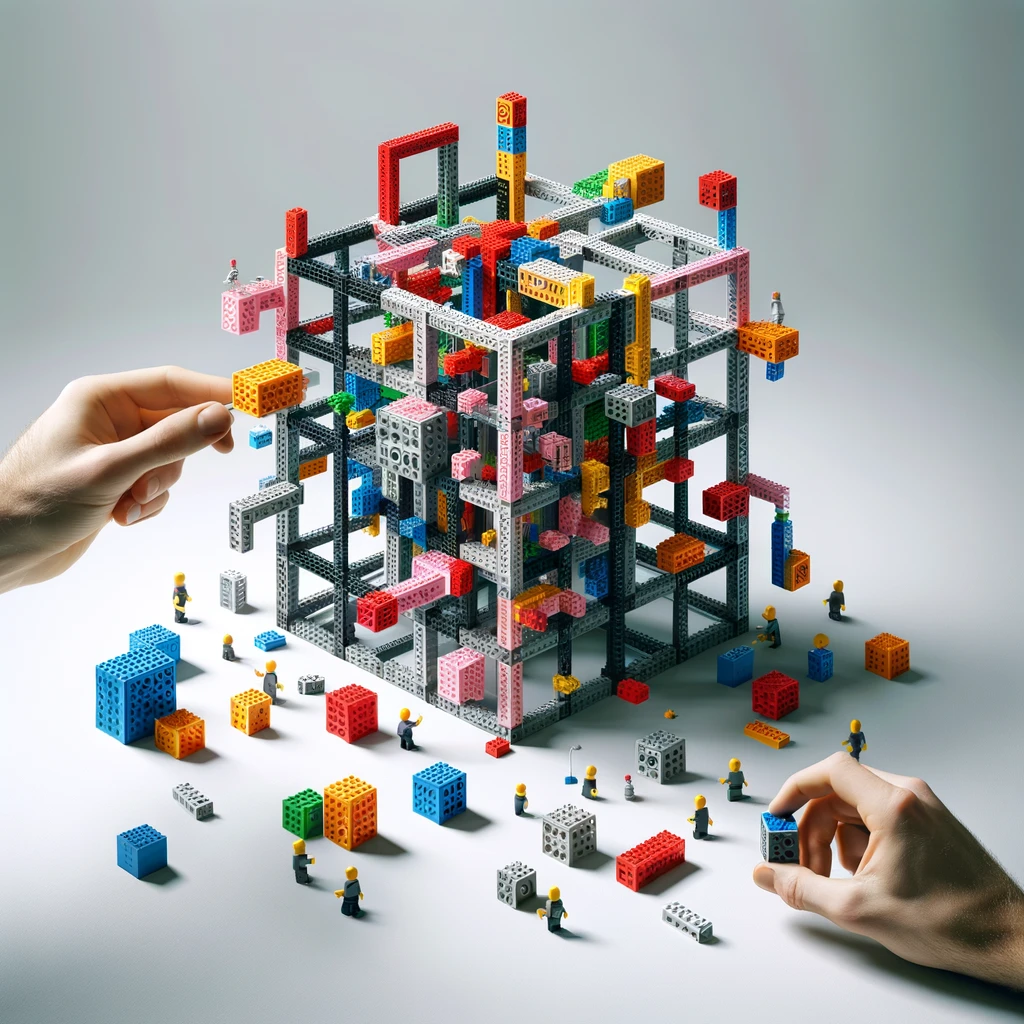
Ideally, you would like to combine a rich variation offered to the market with a low internal cost of complexity. Modularization offers exactly that – rich ends from simple means – a pattern found everywhere in natural systems.
At the same time, modularization can support sustainability and circular economy principles by enabling products and components to be upgraded, repaired and reused over time instead of completely replaced. This creates opportunities for longer product lifecycles, improved resource efficiency and more circular business models.

How modularization can help you
- Your modularization initiative can start in many ways, for instance with a simple “diagnosis” of your current product program: what is the potential for modularization and what are the possibilities and readiness in the organization?
- Commonality analyses can offer insights into how different products differ from each other.
- Cost of complexity analyses reveal the extent to which e.g. the amount of part numbers drive cost in different parts of the organization.
- Customer needs analyses can tell you how well your products cover different customer needs in the market.
Modularization helps companies support circular economy principles by enabling products and components to be reused, repaired and upgraded more efficiently, extending product lifecycles while reducing waste and resource consumption.
We can help you on your modularization journey
We have 30 years of experience which has led us to several efficient methods to grasp the situation, see the opportunities and solve the problems that companies face.
Interested in some of our cases?
Do you want to know more? Keep on reading to learn about our insights about modularization.
Creating many configurations of a few components
One of the primary cost drivers in industrial systems is the number of unique part numbers. Parts need to be developed, tested, drawn, prototyped, produced/sourced, transported, forecasted and stored within the system. Modularization takes advantage of the fact that the product structure has depth – i.e. the products are made up of subcomponents allowing for efficient combinations – and width: with a product range you can find similarities and reuse parts between products in the range.
A way of thinking
To gain success with modularization it is important not to focus blindly on certain methods, but rather acknowledge that modularization primarily is a way of thinking. Just like customers, companies and their products also differ a lot from each other. Modularization and how it is practiced will therefore look quite different in different places. But the same basic principles and thinking can be applied to a wide range of situations.
The phrase ‘rich ends from simple’ reveals that modularization is as much about the commercial side of the business as it is about the industrial/internal side. This means that most parts of the company will be involved in – or affected by – a new modularized product program. It is therefore important that management too is involved in order to facilitate the changes that are needed.
A possibility for sustainability
Modularization can play an important role in supporting sustainability by enabling more circular ways of designing, producing and maintaining products over time. Through modular product structures, organizations can create products that are easier to repair, upgrade, reuse and adapt instead of replacing entire systems. This supports the transition toward circular economy principles and circular business models where value is created through longer product lifecycles, improved resource efficiency and reduced waste.
The growing focus on sustainability and new EU regulations, such as the Right to Repair initiative, further increases the importance of modular thinking. Products designed around modular principles are often better equipped to meet future demands for reparability, maintainability and long-term resource efficiency while simultaneously strengthening operational flexibility and competitiveness.